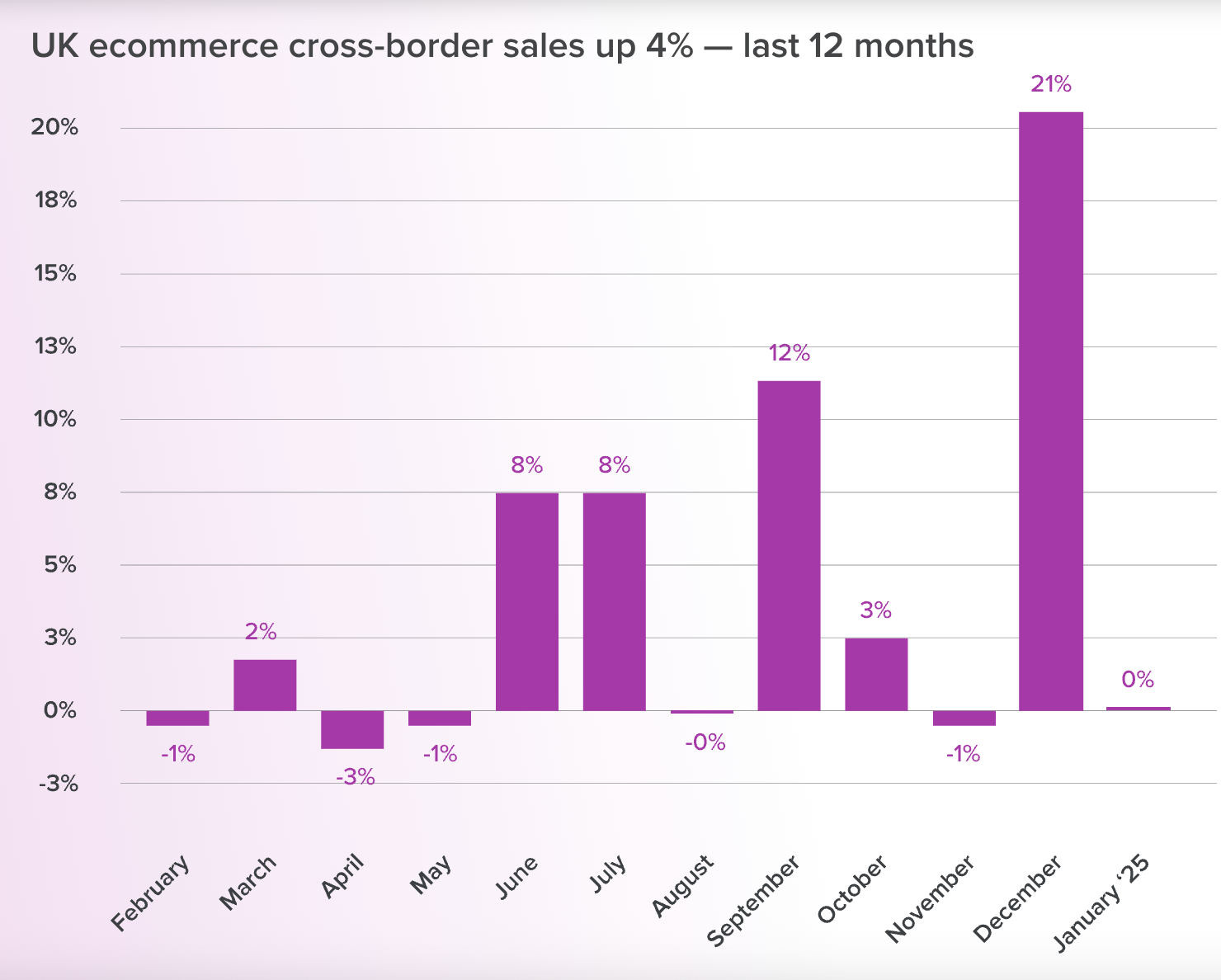
In 2024–2025, UK cross-border ecommerce grew 4% YoY while EMEA-wide cross-border growth reached 6%, according to a recent report from Signifyd.
For UK B2C brands operating in a maturing domestic market, the case for cross-border expansion has never been more concrete
Your next customers are already shopping internationally. Klaviyo helps you reach them.
Cross-border ecommerce is the online sale of goods and services to customers in other countries, without requiring a physical presence in those markets. It allows UK B2C brands to reach global audiences through digital storefronts, international shipping, and localised marketing, without the overhead costs of traditional physical expansion.
Selling internationally means coordinating payments, currency conversion, fulfilment, and marketing across multiple countries from a single operation.
Disclaimer: This content is informational and not legal advice. Please consult qualified counsel for guidance specific to your markets.
Here are 7 of the main benefits you might see from adopting a cross-border ecommerce strategy:
1. Expanded market reach
59% of global shoppers buy from retailers in other countries. For UK B2C brands feeling the squeeze of a crowded domestic market, that's active demand already looking for somewhere to land.
The 4 most logical first markets for UK brands are the EU, US, Australia, and Canada. These markets share language or cultural familiarity with the UK, have mature ecommerce infrastructure, and represent the largest pools of international buyers most likely to respond to British brands.
Market | Why it works for UK brands | Key consideration |
EU | Geographic proximity, mature ecommerce adoption, cultural overlap | Post-Brexit customs processes and tariffs |
US | English-speaking market, largest accessible Western ecommerce economy, strong appetite for British brands | Higher shipping costs and longer delivery times |
Australia | English-speaking market, strong DTC adoption | Longer fulfilment timelines and inventory planning |
Canada | English-speaking market, familiar consumer expectations | Currency conversion and customs duties |
Since Brexit, selling into the EU has involved more customs processes and operational complexity. Many UK B2C brands are now building international strategies that treat the EU, US, Australia, and Canada as a portfolio rather than a ranked list, testing demand across markets before committing budget.
2. Diversification of revenue streams and lower domestic dependency
Relying solely on the domestic market ties performance to factors largely outside your brand's control: consumer confidence, interest rates, and retail sentiment.
Spreading revenue across multiple international markets reduces that exposure in 3 practical ways:
- Revenue resilience across markets: Performance in the EU, US, Australia, or Canada can offset domestic slowdowns, since independent demand cycles reduce overall volatility and support steadier growth.
- Seasonal smoothing: Regional commercial calendars differ. UK and US Q4, for example, are concentrated around Black Friday and Christmas, while continental Europe often shows stronger summer trading. Distributing demand across those cycles stabilises cash flow throughout the year.
- Protection from local shocks: Regulatory changes, VAT adjustments, or sector-specific downturns in one market are less damaging when revenue is spread geographically. Strategies for tariffs and fulfilment planning are worth reviewing early in any expansion.
3. Lower customer acquisition costs and better profit margins
Paid media in the UK is getting expensive. More brands compete for the same audiences, which pushes acquisition costs up, and incremental gains from optimisation are increasingly marginal.
Entering international markets before they reach the same level of competition can help reset that equation. When it comes to your ecommerce customer acquisition strategy, selling internationally can improve your margins in 3 ways:
- Lower acquisition costs in less competitive markets: Some EU markets cost less to advertise in than the UK. UK Facebook CPMs, for example, are among the highest in Europe, with Germany and several other EU markets coming in noticeably cheaper. If your brand is spending heavily on Meta in the UK, testing those other markets can stretch the same budget further.
- Stronger pricing for British brands: In fashion, skincare, homeware, and specialty goods, UK heritage often carries a quality premium abroad. Customers will still pay more for British-made goods as long as they know what to expect on delivery times and costs.
- Shared costs across more revenue: When sales come from multiple markets, your creative, technology, and team costs are spread across a larger customer base. Margins improve without needing to add proportional headcount or spend.
Let’s say you’re a UK homeware brand spending heavily on Meta in London, where you’re competing against dozens of similar brands for the same shoppers. Testing campaigns in Germany or the US may surface less crowded audiences with stronger average order values. With local pricing and honest shipping communication, margins can stay healthy even with more complex fulfilment.
4. Stronger brand awareness and global positioning
Selling internationally builds brand recognition that compounds over time. As customers in a new market become familiar with your brand, search for you directly, and leave reviews, you spend less to reach the next customer there. That makes international brand building worth investing in deliberately, rather than just waiting for it to happen as a side effect of selling abroad.
3 mechanisms drive better-performing investments:
- Presence in high-growth regions: Visibility across the EU, US, and other markets helps you get in front of larger audiences and attract distribution partners and stockists that want to work with brands that already have international traction. Logistics partners and marketplaces also tend to prioritise brands with consistent international volume.
- Participation in local seasonal moments: Taking part in Black Friday in the rest of Europe, summer sales, or regional promotional periods builds local familiarity that compounds over time. A brand that shows up consistently in market-specific moments earns trust that generic global campaigns tend not to.
- Wholesale and distribution opportunities: Retailers, distributors, and marketplace partners in new markets are more likely to work with brands that already have visible customer demand there. International brand recognition generates inbound commercial opportunities that brands entering a market from scratch have to go out and create themselves.
Castore, the British precision sportswear brand, shows how international brand building plays out at scale. By the end of 2024 they had grown from 25 to over 50 stores across the UK and Europe, operating across 26 regional accounts to keep customer communications consistent while expanding into new markets.
6. Richer customer data and localisation insight
Selling across multiple markets gives you information that staying in one market never will. You learn which countries buy most readily, which products sell better abroad than at home, and which messages connect with different audiences. The longer you sell internationally, the more useful that picture becomes.
Here are 3 areas where those insights show up:
- Which markets are worth more of your budget: Once you can see conversion data by country, accounting for local currency and shipping, you’ll notice that some markets clearly outperform others. That lets you invest more money where it’s actually working.
- Which products travel: A product that sells steadily in the UK might also be one of your best performers in Germany or the US. Knowing this changes how you plan stock, time launches, and decide what to promote in each market.
- What messaging works where: The copy, design, offer types, and channel mix that convert in the UK might perform differently in France or Scandinavia. Building up that knowledge gives you a practical localisation guide that no generic template can replace.
Let’s say you’re a UK B2C jewellery brand and your data suggests that minimalist designs convert strongly in Scandinavian markets, while statement pieces outperform in Southern Europe. Those patterns change how you brief creative, plan paid spend, and even think about packaging. Over time, they help you anticipate what each market wants, so you’re not reacting after the fact.
An autonomous B2C CRM like Klaviyo unifies all of your customer data across your tech stack into one place, giving you a single view of how each customer behaves across every market you sell in. That makes it easier to act on what you’re learning without jumping between separate reports or systems. |
7. Higher LTV through international retention
Acquiring a customer in a new country is the starting point. Keeping them coming back is where cross-border expansion becomes profitable. Without post-purchase communication that matches what international customers actually expect, acquisition costs stay high, returns increase, and the economics of selling abroad never fully work in your favour.
3 approaches separate brands that retain international customers from those that just acquire them:
- Post-purchase communication that matches local expectations: A UK customer expecting next-day delivery and an Australian customer waiting 7–10 days need very different communication after they buy. Sending the same post-purchase sequence to both creates friction. Delivery updates, product education, and cross-sell suggestions all work better when they reflect what’s normal in each market rather than defaulting to UK expectations.
- Win-back timing that fits local shopping habits: Re-engagement works best when it lands at the right moment. A lapsed customer in Germany might not think twice about a UK Boxing Day email. Rather than copying your UK win-back calendar across every market, align re-engagement triggers with each country's own commercial rhythm. That could mean shifting your biggest win-back push to match local sale seasons, adjusting the lapsed-customer window based on how frequently people shop in that market, or changing the discount structure to reflect local expectations around promotions.
- Choosing the right channels for each market: WhatsApp marketing in Europe works differently by country. In some markets it drives urgency effectively. In others it feels intrusive if you don’t handle it carefully. Getting channel mix right by market matters as much as getting the message right.
Is cross-border ecommerce right for your brand?
Expanding internationally means managing customs and tariffs, post-Brexit trade rules, localisation, payment methods, currency handling, and international shipping. That's a lot of moving parts, but the brands that get it right unlock revenue that doesn't depend on a single market.
Klaviyo gives you the infrastructure to run it all from one platform:
- Market-level segmentation and personalised flows. Segment profiles by country and use conditional splits inside flows to adapt content, timing, and offers per market, without building separate automations for each one.
- Omnichannel messaging from one workspace. Reach customers across email, text message, WhatsApp, and push notifications from the same place, so you can lean into whichever channels perform best in each market.
- Geography-based reporting. Track revenue, repeat purchase rate, and customer lifetime value by country to see which markets are worth scaling and which need a different approach.
- Predictive analytics per customer. Churn risk scoring and expected next order date give you a head start on re-engagement before you lose international customers who are harder to win back.
- 350+ integrations syncing in real time. Customer profiles stay current across every platform in your stack, no matter how many markets you're operating in.
International expansion gets complicated fast. Klaviyo simplifies it.
Cross-border ecommerce FAQs
What are the biggest challenges of cross-border B2C for UK brands?
The main hurdles are managing customs and tariffs, post-Brexit trade requirements, international shipping costs, and localisation of websites, messaging, and payments.
How much does it cost to start selling internationally as a UK brand?
It depends on your market entry strategy. Costs include shipping, localisation budgets, and currency conversion, affecting both your initial investment and ongoing operations.
Which countries buy the most from UK online retailers?
The UK's cross-border ecommerce exports broadly mirror its overall trade relationships. According to the UK Department for Business and Trade, the United States is the UK's largest export market overall, accounting for 22.4% of total UK exports in 2024, followed by Germany (6.9%), the Netherlands (5.9%), and Ireland (5.8%). For goods specifically, the US leads at 15.6%, with Germany at 8.9% and the Netherlands at 7.2%.
Do UK brands need a separate website to sell cross-border?
Not always. Localised or multilingual storefronts can support global ecommerce from a single platform.
How does cross-border ecommerce differ from domestic ecommerce for tax and VAT purposes?
VAT, international sales tax, UK ecommerce tax, and customs duties vary by market. Post-Brexit rules make planning ahead essential.
Is cross-border ecommerce worth it for small UK B2C brands?
Absolutely. UK B2C brands can achieve strong ROI from selling internationally, growing their business, spreading risk, and opening new revenue streams.

Related content