B2C stands for “business to consumer.” Unlike B2B marketing, which is about promoting products to businesses, B2C marketing is about finding the best ways to promote your products to individuals.
While there’s some overlap between B2C and B2B marketing strategies, B2C marketing is geared more toward emotion, instant gratification, and personalised experiences. Sales cycles tend to be shorter, sales volume needs to be higher, and top-of-mind brand awareness metrics are more important.
The thing is, B2C businesses face a lot of competition and high expectations. Amazon has conditioned customers to expect effortless shopping experiences marked by fast delivery, seamless check-out, and personalised suggestions tailored to where they browsed, clicked, and bought. Anything less feels subpar.
Your mission as a B2C marketer is to produce always-on, personalised experiences that can differentiate your products and keep your brand top of mind.
What is B2C marketing?
B2C marketing refers to the tactics and strategies you use to promote your products to individual consumers, rather than companies. From crafting compelling content to delivering personalised messages, it involves communicating with your prospects and customers in a way that builds relationships, drives sales, and increases loyalty.
B2C vs. B2B marketing: what’s the difference?
Besides the obvious difference in audiences—individual consumers shopping for themselves or others, vs. decision makers shopping for their businesses—here are 6 differences between B2C and B2B marketing that can help you allocate resources:
1. Time to purchase
1
A sales cycle is the amount of time between awareness and purchase. While some B2C purchases have longer sales cycles—think expensive items like cars and high-end jewelry—the vast majority of them have shorter sales cycles than B2B purchases.
2. Marketing assets
2
Whereas B2B marketing tends to focus on establishing credibility through research reports, case studies, and webinars, B2C marketing assets educate and entertain with short-form video, newsletters, text messages, eye-catching ads, and quick hits of social proof.
3. Promotion channels
3
B2B marketing reaches people on channels associated with work. B2C marketing, by contrast, is a more omnichannel experience. In B2C, omnichannel marketing examples span organic and paid search, email, text messaging, WhatsApp, mobile push, and social media.
4. Loyalty mechanisms
4
Whereas B2B companies rely mostly on recurring monthly or annual subscriptions to generate repeat purchases, B2C businesses generate customer loyalty through gamification, points, tiers, and a thoughtful post-purchase experience.
5. Success metrics
5
There’s a lot of overlap between B2B and B2C marketing metrics—conversions, customer lifetime value (LTV), and customer acquisition costs (CACs) are universally important, for example. But engagement and website metrics matter much more to B2C marketers because clicks, shares, and other website behaviour are meaningful precursors to buying, and they’re necessary for the behavioural segmentation that creates personalised experiences.
6. Messaging emphasis
6
B2B marketing is (mostly) about appealing to logic, whereas B2C marketing must address both the logical and emotional motivations for making a purchase, whether through nostalgia, joy, or even a sense of urgency.
Understanding the modern B2C consumer lifecycle
A quick recap: Amazon raised consumer expectations to new heights with one-click check-out and advanced product recommendation algorithms. B2C marketers are now expected to create cohesive, personalised experiences across multiple channels. And the average B2C consumer makes purchases based on emotion, personal values, and urgency.
To understand how to operate effectively in this challenging environment, let’s break down the modern B2C customer lifecycle as your starting point.
1. Awareness
The awareness stage begins when someone realises they have a logical and/or emotional need—and they’re eager to find potential products that can meet these needs.
At this stage, a person may not have interacted with your brand in a way you can see and measure. But it’s important that your brand is top of mind nonetheless.
This is why discovery channels, such as organic search, social media, and LLMs, are so fundamental for the awareness stage. LLMs help consumers with discovery by recommending product listings, generating comparisons, and summarizing customer reviews.
With AI platforms like ChatGPT and Claude, consumers are discovering and comparing new products within the same chat interface: 43% of consumers have used AI when shopping for non-essential products in the past 6 months, according to our AI consumer trends research, and 39% have purchased a product recommended by AI during that time period, too.
2. Consideration
In the consideration stage, a consumer has a few brands in mind that can solve their initial problem. This is when they compare prices, features, and other lifestyle factors that products in your category address. They might:
They might also ask an AI platform or branded AI agent to help them compare products: according to a 2026 survey by Gartner, 31% of consumers report that AI overviews lead them to think about more product options. With so much information instantly available, consumers are spending more time weighing their options.
At this stage, the most important thing someone can do is give your brand permission to contact them. When someone signs up for marketing updates from your brand, they’re opening the door to the next stage: conversion.
3. Conversion
In the conversion stage, potential customers turn into actual customers. It’s the point at which someone has enough information to feel confident in their decision to buy.
But that doesn’t mean they’ll buy immediately. If their need isn’t urgent, savvy shoppers may hold out for a limited-time offer that creates the urgency they need to purchase. Others might almost buy, but abandon their carts because something made them think twice—high shipping fees, long shipping timelines, an inconvenient returns policy, etc.
In other words, the conversion stage isn’t a done deal. It’s a fickle stage that can be disrupted by perceived complexity and inconvenience during the purchase process, and it’s important for brands to understand, with real-time data, when people are dropping off.
4. Fulfillment
Between placing an order and receiving it, a consumer enters the fulfilment stage of the lifecycle. During this stage, people expect to see order confirmation and shipping confirmation messages to track their order and make sure it hasn’t disappeared into the online shopping ether.
While the fulfilment stage is ultimately about sending post-purchase emails and mobile messages that don’t sell, people still appreciate good customer service. This means they’ll likely welcome educational content that teaches them how to make the most of their purchase, or the opportunity to chat with an AI customer agent to ask product questions or initiate a return or exchange.
Once the customer receives their order, your goal is to eventually move them to the next stage of the lifecycle for repeat revenue.
5. Loyalty
This is an important moment for your brand and your customers. It’s the moment your customer will decide to buy again or not.
If they’re happy and you sell products that make sense to purchase again, they’re more likely to return for more. At this stage, a satisfied customer might:
Now that you have an understanding of the B2C customer lifecycle, let’s match stages to some of the core B2C marketing strategies you’ll need to see success.
1. Search engine optimisation (SEO)
Stages: awareness, consideration
SEO is the process of creating content for your website in a way that helps you rank in search results. The channel informs awareness when results pop up from general keyword searches, like “high-quality denim for men,” and consideration when people are searching for specific brands they already know could serve their needs.
For ecommerce B2C brands, it’s important to add product structured data to your product pages. Structured data includes information like:
High-quality images
Detailed product descriptions
Price
Shipping details
Sales, discounts, and offers
This information can help you rank in enriched search items like product snippets, popular products widgets, the shopping knowledge panel, and Google images.
SEO now extends beyond traditional search engines. Shoppers are increasingly starting product research in answer engines like ChatGPT, Gemini, Claude, and Google AI Overviews, which means brands also need to think about answer engine optimisation (AEO). The goal of AEO is for AI models to cite your content, and while many SEO practices are transferable, the main difference is that content is optimised for long-tail conversations rather than keywords.
To make your store discoverable in AI search, configure your robots.txt to allow AI crawlers, use schema markup and accurate product identifiers so LLMs can verify your products, and add contextual detail to product descriptions that goes beyond features to address specific buyer concerns. AEO-friendly content formats like detailed FAQs, buying guides, comparison pages, and customer reviews give AI models the context they need to recommend your brand in response to goal-based queries.
Take a look at how toothpaste brand Hismile shows up in a popular products widget. While the toothpaste brand’s product listing shows up alongside other listings from different sellers, Hismile’s owned listing competes with more customer reviews and a 30-day return policy.
2. Social media engagement
Stages: awareness, consideration
B2C marketing relies on platforms like Instagram, TikTok, and Snapchat to attract a broad audience during awareness and consideration stages. User-generated content, influencer collaborations, behind-the-scenes glimpses, and interactive features like polls and stories are all great ways to use social media to connect more deeply with your audience.
Social media for B2C ecommerce brands is about learning the conventions of your niche with an understanding of how your audience might want you to play with those conventions.
3. Email, text message, mobile push, and WhatsApp marketing automation
When they’re personalised and/or automated, your owned marketing channels are tried-and-true, cost-effective ways to hit almost every stage of the customer lifecycle.
Marketing campaigns are staples of any B2C marketing strategy, so you’re not wrong to keep sending them. But automations are where you can expect to see revenue with much less effort. This is because automations are messages triggered by behaviour, like product browsing, cart abandonment, and other actions that signal someone is about to buy again. If you're building this capability out, here's how to develop a marketing automation strategy.
In other words, when they’re informed by rich audience data, your owned marketing channels are how smaller B2C brands can deliver that personalised, Amazon-like shopping experience that’s now so important to consumers.
When someone abandons a cart on the Dr. Martens website, the brand sends a reminder that leans on its casual, friendly tone of voice to win shoppers back. It's a good alternative to leading with a discount, which can still be effective, especially for high-value carts you really want to nab.
4. Loyalty programmes and gamification
Stages: fulfilment, loyalty
Customer loyalty programs are important because repeat customers tend to be worth more than one-time customers. By offering memberships, points-based rewards, or VIP experiences, you can turn one-time buyers into lifelong advocates.
There are 5 main types of loyalty programs you can try:
1. Points-based loyalty programmes
1
Customers accumulate points from purchases and redeem those points for discounts, freebies, and cash-backs.
2. Tiered loyalty programmes
2
Customers access different levels of benefits based on behaviour like purchase volume or order history.
3. Paid loyalty programmes
3
Customers pay to receive premium benefits for their brand loyalty.
4. Partnered loyalty programmes
4
Companies within complementary industries that are not competitors work together to create a loyalty programme.
5. Gamified loyalty programmes
5
Brands incentivise actions by turning them into small games or competitions, then awarding benefits upon successful completion. To be successful, gamified loyalty programs need to be, well, fun, just like any other game.
5. Omnichannel, AI-powered personalisation
Stages: consideration, conversion, fulfillment, and loyalty
People interact with brands across multiple channels—your website, social media, email, and physical stores. Omnichannel marketing is the practice of delivering a consistent ecommerce personalisation, experience across all these touchpoints to build trust and loyalty.
Personalised omnichannel marketing requires two things: a centralised customer profile that calibrates a better customer experience across whatever marketing and sales channels the customer chooses, and AI.
The customer profile is what makes it possible for someone to click on an Instagram ad, place an item in their cart, abandon that cart, and then complete a purchase after getting an email with a discount code for the product they abandoned.
AI that’s trained on the data in those profiles and built into the same system that orchestrates your marketing, meanwhile, is what makes it possible to:
Generate on-brand, personalised marketing campaigns in minutes, by prompting an AI marketing agent with a goal or idea and then reviewing, refining, and approving the copy, visuals, audience segments, and timing it recommends.
Tailor content, timing, channel mix, and more to the individual subscriber, not just different audience segments.
Personalise cross-channel marketing based on what customers are likely to do in the future, not just what they’ve done in the past.
Guide customers toward first and repeat purchases in conversations with AI customer agents, which can also assist with post-purchase support like order tracking, return initiation, and product questions.
How to start building strong customer relationships with B2C marketing
Your B2C marketing promotion channels are only effective if you’re using them to build strong, empathetic relationships with your audience.
If you’re wondering how to begin connecting more deeply with your customers, here are 3 great places to start:
1. Learn from success stories
There’s no need to reinvent the wheel. The benefit to facing a lot of competition is that you’re also in a great position to learn from brands in your niche, then spot how you can do better.
Take inspiration from men's personal care brand Every Man Jack, for example, which drove a 25% YoY increase in flows revenue by sending messages to customers based on their AI-generated predicted next order date, data brands couldn't conceive of having just a short time ago.
2. Personalise your messages with data
Digital lives are noisy ones, and people only click on what’s relevant to them at that moment. This is why personalisation is no longer a nice-to-have, and it’s no longer just a first name in an email.
But before you can move toward Amazon-level personalisation, you need the audience data to inform it—and you need it all in one place. Invest in a B2C CRM that can:
Generate behavioural data from your online channels.
Segment your audience based on that behaviour.
Send personalised messages that reflect not only how someone has actually interacted with your brand, but how they’re likely to interact in the future.
Use built-in agentic AI to generate marketing assets faster, then recommend how to personalise their content, timing, and channel mix for different subscribers.
When travel brand July started sending a targeted email promoting a new product colour to customers within a 20-kilometre radius of their retail locations in Melbourne, Sydney, and Brisbane, it contributed to 52% YoY growth in Klaviyo-attributed revenue.
3. Lead with empathetic communication
Customers remember brands that treat them like people, not transactions. The great news is that when you have data that can help you get to know members of your audience, you’re in a great position to send messages that lead with empathy.
There are many ways to infuse empathy into your messages, but every one of them starts with a basic principle: that the needs of your audience come before the interests of your brand. Some would even say they’re one and the same.
Take a look at this holiday message from Culture Kings as an example—it’s all about their audience. The brand thanks their community for a great year, then consolidates their Boxing Day sale links in one convenient place.
Source: Milled
Next steps: sourcing a B2C-specific tech stack
The reality is, many of the tools B2C marketers rely on today, like CRMs designed for B2B marketing, can’t deliver the personalised shopping experience consumers expect. Traditional CRMs, while powerful, often lack the consumer-first features needed to address the fast-paced, emotionally driven nature of B2C interactions.
This is where Klaviyo stands apart. Built exclusively for B2C businesses, Klaviyo combines robust data integration, cross-channel marketing campaigns and automation, customer service capabilities, reporting and analytics, and agentic AI to create seamless, emotionally resonant experiences.
Whether you're launching a complicated cross-channel marketing campaign, building automated flows based on predictions about customer behaviour, or using built-in AI to generate on-brand marketing assets fast, Klaviyo empowers you to deliver what today's consumers crave: relevance and authenticity.
Ready to transform your B2C marketing strategy? Get started
Tiff (she/they) is a writer and content consultant who specializes in marketing, health, and the attention economy. Before devoting herself to freelance writing full-time, they led content teams at various startups and nonprofits in Toronto, Canada.
Customer service metrics in 2026 aren’t just about service. They can also generate revenue. Learn more about the seven metrics you should be tracking this year.
Learn how unifying customer service and marketing data improves personalisation, efficiency, and revenue—and why a shared CRM foundation matters.
# Exceptional B2C marketing in 2026: how to resonate with your customers
B2C stands for “business to consumer.” Unlike B2B marketing, which is about promoting products to businesses, B2C marketing is about finding the best ways to promote your products to individuals.
While there’s some overlap between B2C and B2B marketing strategies, B2C marketing is geared more toward emotion, instant gratification, and personalised experiences. Sales cycles tend to be shorter, sales volume needs to be higher, and top-of-mind brand awareness metrics are more important.
The thing is, B2C businesses face _a lot_ of competition and high expectations. Amazon has conditioned customers to expect effortless shopping experiences marked by fast delivery, seamless check-out, and personalised suggestions tailored to where they browsed, clicked, and bought. Anything less feels subpar.
Your mission as a B2C marketer is to produce always-on, personalised experiences that can differentiate your products and keep your brand top of mind.
## What is B2C marketing?
B2C marketing refers to the tactics and strategies you use to promote your products to individual consumers, rather than companies. From crafting compelling content to delivering personalised messages, it involves communicating with your prospects and customers in a way that builds relationships, drives sales, and increases loyalty.
## B2C vs. B2B marketing: what’s the difference?
Besides the obvious difference in audiences—individual consumers shopping for themselves or others, vs. decision makers shopping for their businesses—here are 6 differences between B2C and B2B marketing that can help you allocate resources:
```json
{
"_key": "2a48b890-3c4f-4aff-b468-e89e79e4737c",
"_type": "steps",
"steps": [
{
"_key": "2c9e3565-bffc-4db3-8378-d0bd4a822ab9",
"_type": "step",
"body": [
{
"_key": "6pHz6MgKhT64plXvVKhf6J",
"_type": "block",
"children": [
{
"_key": "6pHz6MgKhT64plXvVKhf8E",
"_type": "span",
"marks": [],
"text": "A sales cycle is the amount of time between awareness and purchase. While some B2C purchases have longer sales cycles—think expensive items like cars and high-end jewelry—the vast majority of them have shorter sales cycles than B2B purchases."
}
],
"markDefs": [],
"style": "normal"
}
],
"title": "1. Time to purchase"
},
{
"_key": "62138683-19cf-4579-954b-9cc30649b5d9",
"_type": "step",
"body": [
{
"_key": "6pHz6MgKhT64plXvVKhfA9",
"_type": "block",
"children": [
{
"_key": "6pHz6MgKhT64plXvVKhfC4",
"_type": "span",
"marks": [],
"text": "Whereas B2B marketing tends to focus on establishing credibility through research reports, case studies, and webinars, B2C marketing assets educate and entertain with short-form video, "
},
{
"_key": "6pHz6MgKhT64plXvVKhfDz",
"_type": "span",
"marks": [
"link-fqog5sr"
],
"text": "newsletters"
},
{
"_key": "6pHz6MgKhT64plXvVKhfFu",
"_type": "span",
"marks": [],
"text": ", "
},
{
"_key": "6pHz6MgKhT64plXvVKhfHp",
"_type": "span",
"marks": [
"link-t1lmr2l"
],
"text": "text messages"
},
{
"_key": "6pHz6MgKhT64plXvVKhfJk",
"_type": "span",
"marks": [],
"text": ", eye-catching ads, and quick hits of social proof."
}
],
"markDefs": [
{
"_key": "link-fqog5sr",
"_type": "link",
"href": "/uk/blog/how-to-create-an-email-newsletter",
"openInNewTab": false
},
{
"_key": "link-t1lmr2l",
"_type": "link",
"href": "/uk/blog/what-is-sms-marketing",
"openInNewTab": false
}
],
"style": "normal"
}
],
"title": "2. Marketing assets"
},
{
"_key": "e6223c6d-8dbf-4707-8508-9444fd9caff2",
"_type": "step",
"body": [
{
"_key": "c05d0ac8b29d",
"_type": "block",
"children": [
{
"_key": "a8ad6f094efe",
"_type": "span",
"marks": [],
"text": "B2B marketing reaches people on channels associated with work. B2C marketing, by contrast, is a more "
},
{
"_key": "bdac37139dee",
"_type": "span",
"marks": [
"2a8e5eea6b94"
],
"text": "omnichannel "
},
{
"_key": "ebbd869162ad",
"_type": "span",
"marks": [
"681d08407b73"
],
"text": "experience"
},
{
"_key": "385b91512c4f",
"_type": "span",
"marks": [],
"text": ". In B2C, "
},
{
"_key": "08ea9e5b9409",
"_type": "span",
"marks": [
"382646b53955"
],
"text": "omnichannel marketing examples"
},
{
"_key": "df1d4a2423db",
"_type": "span",
"marks": [],
"text": " span organic and paid search, email, text messaging, WhatsApp, mobile push, and social media."
}
],
"markDefs": [
{
"_key": "2a8e5eea6b94",
"_type": "link",
"href": "https://www.klaviyo.com/uk/solutions/omnichannel/what-is-omnichannel-marketing"
},
{
"_key": "681d08407b73",
"_type": "link",
"href": "https://www.klaviyo.com/uk/blog/what-is-omnichannel-marketing"
},
{
"_key": "382646b53955",
"_type": "link",
"href": "https://www.klaviyo.com/uk/blog/omnichannel-marketing-examples"
}
],
"style": "normal"
}
],
"title": "3. Promotion channels"
},
{
"_key": "c99898e9-3f7a-4c4f-ad27-8f03a327202f",
"_type": "step",
"body": [
{
"_key": "6pHz6MgKhT64plXvVKhfVG",
"_type": "block",
"children": [
{
"_key": "6pHz6MgKhT64plXvVKhfXB",
"_type": "span",
"marks": [],
"text": "Whereas B2B companies rely mostly on recurring monthly or annual subscriptions to generate repeat purchases, B2C businesses generate customer loyalty through gamification, points, tiers, and a thoughtful post-purchase experience."
}
],
"markDefs": [],
"style": "normal"
}
],
"title": "4. Loyalty mechanisms"
},
{
"_key": "0c72a3a4-e737-45fe-99bf-3de5ecfaf76d",
"_type": "step",
"body": [
{
"_key": "6pHz6MgKhT64plXvVKhfZ6",
"_type": "block",
"children": [
{
"_key": "6pHz6MgKhT64plXvVKhfb1",
"_type": "span",
"marks": [],
"text": "There’s "
},
{
"_key": "6pHz6MgKhT64plXvVKhfcw",
"_type": "span",
"marks": [
"em"
],
"text": "a lot "
},
{
"_key": "6pHz6MgKhT64plXvVKhfer",
"_type": "span",
"marks": [],
"text": "of overlap between B2B and B2C marketing metrics—conversions, customer lifetime value (LTV), and customer acquisition costs (CACs) are universally important, for example. But engagement and website metrics matter much more to B2C marketers because clicks, shares, and other website behaviour are meaningful precursors to buying, "
},
{
"_key": "6pHz6MgKhT64plXvVKhfgm",
"_type": "span",
"marks": [
"em"
],
"text": "and"
},
{
"_key": "6pHz6MgKhT64plXvVKhfih",
"_type": "span",
"marks": [],
"text": " they’re necessary for the "
},
{
"_key": "6pHz6MgKhT64plXvVKhfkc",
"_type": "span",
"marks": [
"link-c931t7q"
],
"text": "behavioural segmentation"
},
{
"_key": "6pHz6MgKhT64plXvVKhfmX",
"_type": "span",
"marks": [],
"text": " that creates personalised experiences."
}
],
"markDefs": [
{
"_key": "link-c931t7q",
"_type": "link",
"href": "/uk/blog/behavioural-segmentation",
"openInNewTab": false
}
],
"style": "normal"
}
],
"title": "5. Success metrics"
},
{
"_key": "f9ad7cdf-2c19-4927-b8d2-4555d009a2fe",
"_type": "step",
"body": [
{
"_key": "6pHz6MgKhT64plXvVKhfoS",
"_type": "block",
"children": [
{
"_key": "6pHz6MgKhT64plXvVKhfqN",
"_type": "span",
"marks": [],
"text": "B2B marketing is (mostly) about appealing to logic, whereas B2C marketing must address both the logical and emotional motivations for making a purchase, whether through nostalgia, joy, or even a sense of urgency."
}
],
"markDefs": [],
"style": "normal"
}
],
"title": "6. Messaging emphasis"
}
]
}
```
## Understanding the modern B2C consumer lifecycle
A quick recap: Amazon raised consumer expectations to new heights with one-click check-out and advanced product recommendation algorithms. B2C marketers are now expected to create cohesive, personalised experiences across multiple channels. And the average B2C consumer makes purchases based on emotion, personal values, and urgency.
To understand how to operate effectively in this challenging environment, let’s break down the modern [B2C customer lifecycle](https://www.klaviyo.com/uk/blog/customer-lifecycle-marketing-ecommerce) as your starting point.
### 1. Awareness
The awareness stage begins when someone realises they have a logical and/or emotional need—and they’re eager to find potential products that can meet these needs.
At this stage, a person may not have interacted with your brand in a way you can see and measure. But it’s important that your brand is top of mind nonetheless.
This is why discovery channels, such as organic search, social media, and LLMs, are so fundamental for the awareness stage. LLMs help consumers with discovery by recommending product listings, generating comparisons, and summarizing customer reviews.
With AI platforms like ChatGPT and Claude, consumers are discovering and comparing new products within the same chat interface: 43% of consumers have used AI when shopping for non-essential products in the past 6 months, according to our [AI consumer trends research](https://www.klaviyo.com/uk/marketing-resources/ai-consumer-trends), and 39% have purchased a product recommended by AI during that time period, too.
### 2. Consideration
In the consideration stage, a consumer has a few brands in mind that can solve their initial problem. This is when they compare prices, features, and other lifestyle factors that products in your category address. They might:
- Browse your website and product pages.
- Read [product reviews](/uk/blog/online-customer-reviews-for-ecommerce).
- Sign up for your newsletter.
- Follow you on social media.
They might also ask an AI platform or branded AI agent to help them compare products: according to a [2026 survey by Gartner](https://www.gartner.com/en/newsroom/press-releases/gartner-survey-finds-only-one-third-of-consumers-say-genai-rivals-search-engines-marketers-must-optimize-for-both-ai-driven-and-traditional-search), 31% of consumers report that AI overviews lead them to think about more product options. With so much information instantly available, consumers are spending more time weighing their options.
At this stage, the most important thing someone can do is give your brand permission to contact them. When someone signs up for marketing updates from your brand, they’re opening the door to the next stage: conversion.
### 3. Conversion
In the conversion stage, potential customers turn into actual customers. It’s the point at which someone has enough information to feel confident in their decision to buy.
But that doesn’t mean they’ll buy immediately. If their need isn’t urgent, savvy shoppers may hold out for a limited-time offer that _creates_ the urgency they need to purchase. Others might almost buy, but [abandon their carts](/uk/blog/abandoned-cart-email) because something made them think twice—high shipping fees, long shipping timelines, an inconvenient returns policy, etc.
In other words, the conversion stage isn’t a done deal. It’s a fickle stage that can be disrupted by perceived complexity and inconvenience during the purchase process, and it’s important for brands to understand, with real-time data, when people are dropping off.
### 4. Fulfillment
Between placing an order and receiving it, a consumer enters the fulfilment stage of the lifecycle. During this stage, people expect to see [order confirmation](/uk/blog/order-confirmation-email-tips-and-examples) and [shipping confirmation](/uk/blog/shipping-confirmation-email-template-examples) messages to track their order and make sure it hasn’t disappeared into the online shopping ether.
While the fulfilment stage is ultimately about sending [post-purchase emails](https://www.klaviyo.com/uk/blog/post-purchase-emails) and mobile messages that don’t sell, people still appreciate good customer service. This means they’ll likely welcome educational content that teaches them how to make the most of their purchase, or the opportunity to chat with an [AI customer agent](https://www.klaviyo.com/uk/solutions/ai/customer-agent) to ask product questions or initiate a return or exchange.
Once the customer receives their order, your goal is to eventually move them to the next stage of the lifecycle for repeat revenue.
### 5. Loyalty
This is an important moment for your brand and your customers. It’s the moment your customer will decide to buy again or not.
If they’re happy and you sell products that make sense to purchase again, they’re more likely to return for more. At this stage, a satisfied customer might:
- Share glowing reviews about their experiences.
- Recommend your products to friends and family.
- Join your loyalty program.
- Upgrade to premium versions of what they love.
- Explore and try out other products.
At this point, it’s time to focus on [retention marketing strategies](https://www.klaviyo.com/blog/retention-marketing-strategies-brands) that help keep your customers satisfied.
## 5 key strategies for B2C marketing success
Now that you have an understanding of the B2C customer lifecycle, let’s match stages to some of the core B2C marketing strategies you’ll need to see success.
### 1. Search engine optimisation (SEO)
**Stages:** awareness, consideration
SEO is the process of creating content for your website in a way that helps you rank in search results. The channel informs awareness when results pop up from general keyword searches, like “high-quality denim for men,” and consideration when people are searching for specific brands they already know could serve their needs.
For ecommerce B2C brands, it’s important to add [product structured data](https://developers.google.com/search/docs/appearance/structured-data/product) to your product pages. Structured data includes information like:
- High-quality images
- Detailed product descriptions
- Price
- Shipping details
- Sales, discounts, and offers
This information can help you rank in enriched search items like product snippets, popular products widgets, the shopping knowledge panel, and Google images.
SEO now extends beyond traditional search engines. Shoppers are increasingly starting product research in answer engines like ChatGPT, Gemini, Claude, and Google AI Overviews, which means brands also need to think about answer engine optimisation (AEO). The goal of AEO is for AI models to cite your content, and while many SEO practices are transferable, the main difference is that content is optimised for long-tail conversations rather than keywords.
To make your store discoverable in AI search, configure your robots.txt to allow AI crawlers, use schema markup and accurate product identifiers so LLMs can verify your products, and add contextual detail to product descriptions that goes beyond features to address specific buyer concerns. AEO-friendly content formats like detailed FAQs, buying guides, comparison pages, and customer reviews give AI models the context they need to recommend your brand in response to goal-based queries.
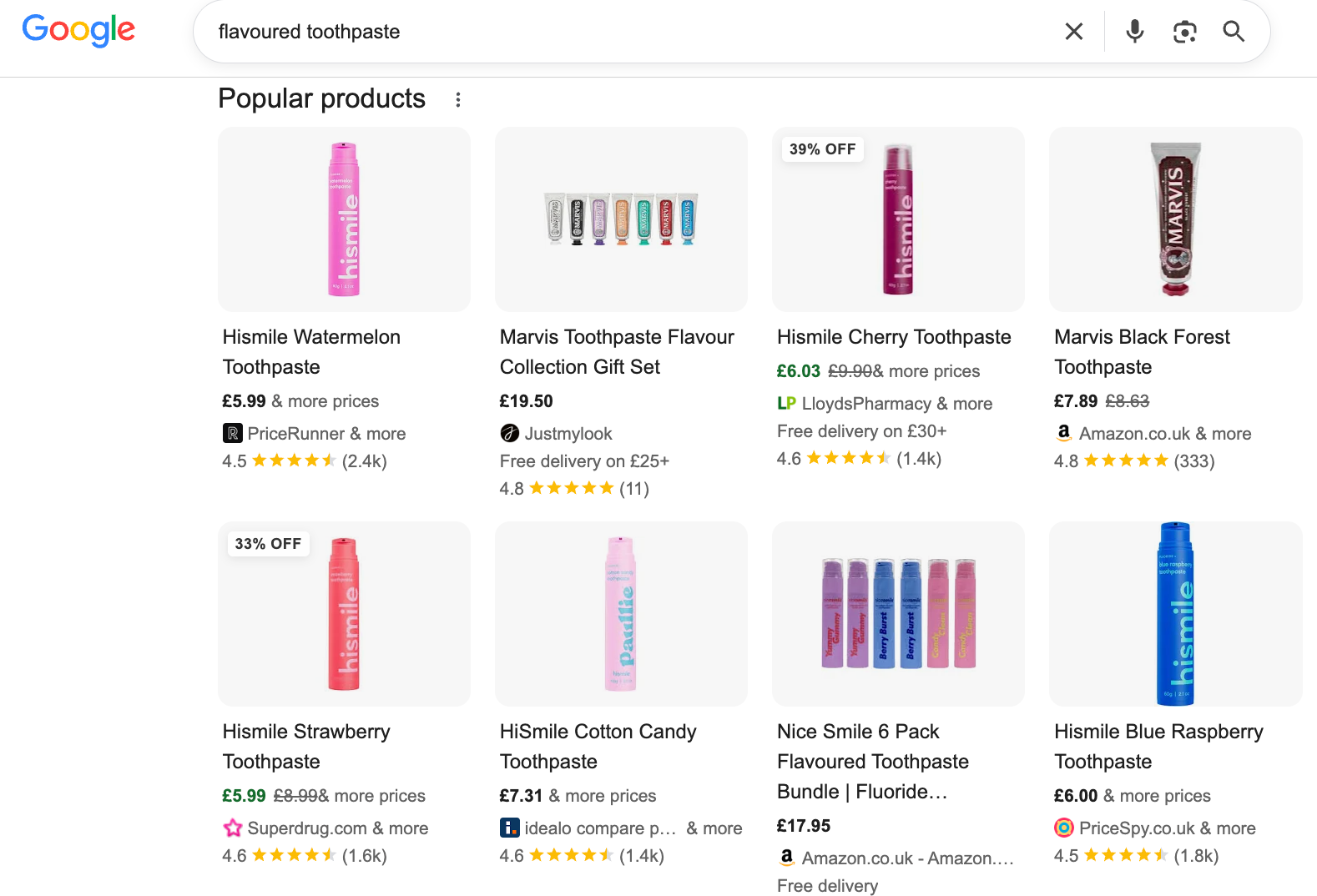
Take a look at how toothpaste brand [Hismile](https://hismileteeth.com/) shows up in a popular products widget. While the toothpaste brand’s product listing shows up alongside other listings from different sellers, Hismile’s owned listing competes with more customer reviews and a 30-day return policy.
### 2. Social media engagement
**Stages:** awareness, consideration
B2C marketing relies on platforms like Instagram, [TikTok](/uk/blog/7-tiktok-ecommerce-strategies), and Snapchat to attract a broad audience during awareness and consideration stages. User-generated content, influencer collaborations, behind-the-scenes glimpses, and interactive features like polls and stories are all great ways to use social media to connect more deeply with your audience.
Social media for B2C ecommerce brands is about learning the conventions of your niche with an understanding of how your audience might want you to play with those conventions.
### 3. Email, text message, mobile push, and WhatsApp marketing automation
**Stages:** consideration, conversion, fulfillment, loyalty
When they’re personalised and/or automated, your owned marketing channels are tried-and-true, cost-effective ways to hit almost every stage of the customer lifecycle.
Marketing campaigns are staples of any B2C marketing strategy, so you’re not wrong to keep sending them. But automations are where you can expect to see revenue _with much less effort_. This is because automations are messages triggered by behaviour, like product browsing, cart abandonment, and other actions that signal someone is about to buy again. If you're building this capability out, here's how to develop a [marketing automation strategy](https://www.klaviyo.com/uk/blog/marketing-automation-strategy).
In other words, when they’re informed by rich audience data, your owned marketing channels are how smaller B2C brands can deliver that personalised, Amazon-like shopping experience that’s now so important to consumers.
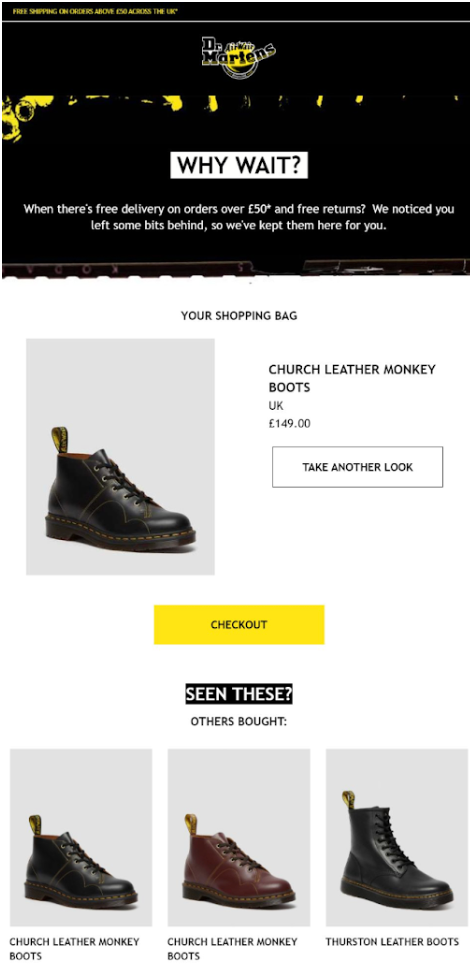
When someone abandons a cart on the [Dr. Martens](https://www.drmartens.com/uk/en_gb/) website, the brand sends a reminder that leans on its casual, friendly tone of voice to win shoppers back. It's a good alternative to leading with a discount, which can still be effective, especially for high-value carts you really want to nab.
### 4. Loyalty programmes and gamification
**Stages:** fulfilment, loyalty
[Customer loyalty programs](https://www.klaviyo.com/uk/blog/customer-loyalty-program) are important because repeat customers tend to be worth more than one-time customers. By offering memberships, points-based rewards, or VIP experiences, you can turn one-time buyers into lifelong advocates.
There are 5 main types of loyalty programs you can try:
```json
{
"_key": "f65e240c-ff50-47cf-ace8-d8553e3e16f3",
"_type": "steps",
"steps": [
{
"_key": "d4a64587-04e9-437e-8ef2-2e9d2d1544ef",
"_type": "step",
"body": [
{
"_key": "6pHz6MgKhT64plXvVKhka2",
"_type": "block",
"children": [
{
"_key": "6pHz6MgKhT64plXvVKhkbx",
"_type": "span",
"marks": [],
"text": "Customers accumulate points from purchases and redeem those points for discounts, freebies, and cash-backs."
}
],
"markDefs": [],
"style": "normal"
}
],
"title": "1. Points-based loyalty programmes"
},
{
"_key": "5365f915-03ec-49d1-a6ad-5fcbaf0e6195",
"_type": "step",
"body": [
{
"_key": "6pHz6MgKhT64plXvVKhkds",
"_type": "block",
"children": [
{
"_key": "6pHz6MgKhT64plXvVKhkfn",
"_type": "span",
"marks": [],
"text": "Customers access different levels of benefits based on behaviour like purchase volume or order history."
}
],
"markDefs": [],
"style": "normal"
}
],
"title": "2. Tiered loyalty programmes"
},
{
"_key": "925d793d-7305-4f88-b044-4b80b3aee7a1",
"_type": "step",
"body": [
{
"_key": "6pHz6MgKhT64plXvVKhkhi",
"_type": "block",
"children": [
{
"_key": "6pHz6MgKhT64plXvVKhkjd",
"_type": "span",
"marks": [],
"text": "Customers pay to receive premium benefits for their brand loyalty."
}
],
"markDefs": [],
"style": "normal"
}
],
"title": "3. Paid loyalty programmes"
},
{
"_key": "c21d4e09-0181-4836-9208-c47aae254770",
"_type": "step",
"body": [
{
"_key": "6pHz6MgKhT64plXvVKhklY",
"_type": "block",
"children": [
{
"_key": "6pHz6MgKhT64plXvVKhknT",
"_type": "span",
"marks": [],
"text": "Companies within complementary industries that are not competitors work together to create a loyalty programme."
}
],
"markDefs": [],
"style": "normal"
}
],
"title": "4. Partnered loyalty programmes"
},
{
"_key": "8e42b70b-f3b4-452c-961d-91d06dd8557b",
"_type": "step",
"body": [
{
"_key": "6pHz6MgKhT64plXvVKhkpO",
"_type": "block",
"children": [
{
"_key": "6pHz6MgKhT64plXvVKhkrJ",
"_type": "span",
"marks": [],
"text": "Brands incentivise actions by turning them into small games or competitions, then awarding benefits upon successful completion. To be successful, gamified loyalty programs need to be, well, fun, just like any other game."
}
],
"markDefs": [],
"style": "normal"
}
],
"title": "5. Gamified loyalty programmes"
}
]
}
```
### 5. Omnichannel, AI-powered personalisation
**Stages:** consideration, conversion, fulfillment, and loyalty
People interact with brands across multiple channels—your website, social media, email, and physical stores. Omnichannel marketing is the practice of delivering a consistent [ecommerce personalisation](https://www.klaviyo.com/uk/blog/ecommerce-personalisation), experience across all these touchpoints to build trust and loyalty.
Personalised omnichannel marketing requires two things: a centralised customer profile that calibrates a better customer experience across whatever marketing and sales channels the customer chooses, and AI.
The customer profile is what makes it possible for someone to click on an Instagram ad, place an item in their cart, abandon that cart, and then complete a purchase after getting an email with a discount code for the product they abandoned.
AI that’s trained on the data in those profiles and built into the same system that orchestrates your marketing, meanwhile, is what makes it possible to:
- Generate on-brand, personalised marketing campaigns in minutes, by prompting an [AI marketing agent](https://www.klaviyo.com/uk/composer) with a goal or idea and then reviewing, refining, and approving the copy, visuals, audience segments, and timing it recommends.
- Tailor content, timing, channel mix, and more to the individual subscriber, not just different audience segments.
- Personalise cross-channel marketing based on what customers are likely to do in the future, not just what they’ve done in the past.
- Guide customers toward first and repeat purchases in conversations with AI customer agents, which can also assist with post-purchase support like order tracking, return initiation, and product questions.
## How to start building strong customer relationships with B2C marketing
Your B2C marketing promotion channels are only effective if you’re using them to build strong, empathetic relationships with your audience.
If you’re wondering how to begin connecting more deeply with your customers, here are 3 great places to start:
### 1. Learn from success stories
There’s no need to reinvent the wheel. The benefit to facing a lot of competition is that you’re also in a great position to [learn from brands in your niche](/uk/customers), then spot how you can do better.
Take inspiration from men's personal care brand [Every Man Jack](https://www.klaviyo.com/customers/case-studies/every-man-jack), for example, which drove a 25% YoY increase in flows revenue by sending messages to customers based on their AI-generated predicted next order date, data brands couldn't conceive of having just a short time ago.
### 2. Personalise your messages with data
Digital lives are noisy ones, and people only click on what’s relevant to them _at that moment._ This is why personalisation is no longer a nice-to-have, and it’s no longer just a first name in an email.
But before you can move toward Amazon-level personalisation, you need the audience data to inform it—and you need it all in one place. Invest in a [B2C CRM](https://www.klaviyo.com/uk/blog/crm-for-b2c) that can:
- Generate behavioural data from your online channels.
- Segment your audience based on that behaviour.
- Send personalised messages that reflect not only how someone has actually interacted with your brand, but how they’re likely to interact in the future.
- Use built-in agentic AI to generate marketing assets faster, then recommend how to personalise their content, timing, and channel mix for different subscribers.
When travel brand [July](https://july.com/) started sending a targeted email promoting a new product colour to customers within a 20-kilometre radius of their retail locations in Melbourne, Sydney, and Brisbane, it contributed to [52% YoY growth in Klaviyo-attributed revenue](https://www.klaviyo.com/customers/case-studies/july).
### 3. Lead with empathetic communication
Customers remember brands that treat them like people, not transactions. The great news is that when you have data that can help you _get to know_ members of your audience, you’re in a great position to send messages that lead with empathy.
There are many ways to infuse empathy into your messages, but every one of them starts with a basic principle: that the needs of your audience come before the interests of your brand. Some would even say they’re one and the same.
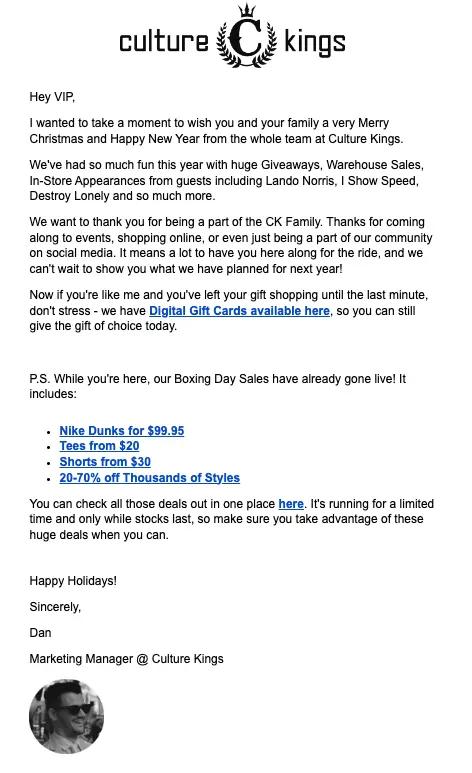
Take a look at this holiday message from [Culture Kings](https://www.culturekings.com.au/) as an example—it’s _all _about their audience. The brand thanks their community for a great year, then consolidates their [Boxing Day sale](https://www.klaviyo.com/uk/blog/boxing-day-sales-email-marketing) links in one convenient place.
## Next steps: sourcing a B2C-specific tech stack
The reality is, many of the tools B2C marketers rely on today, like CRMs designed for B2B marketing, can’t deliver the personalised shopping experience consumers expect. Traditional CRMs, while powerful, often lack the consumer-first features needed to address the fast-paced, emotionally driven nature of B2C interactions.
This is where Klaviyo stands apart. Built exclusively for B2C businesses, Klaviyo combines robust data integration, cross-channel marketing campaigns and automation, customer service capabilities, reporting and analytics, and agentic AI to create seamless, emotionally resonant experiences.
Whether you're launching a complicated cross-channel marketing campaign, building automated flows based on predictions about customer behaviour, or using [built-in AI](https://www.klaviyo.com/uk/blog/klaviyo-advances-ai-first-b2c-crm) to generate on-brand marketing assets fast, Klaviyo empowers you to deliver what today's consumers crave: relevance and authenticity.
Ready to transform your B2C marketing strategy? [Get started](https://www.klaviyo.com/uk/sign-up)
```json
{
"_createdAt": "2026-01-20T02:17:06Z",
"_id": "4d808b96-4faf-44d6-ade2-4a84668e775b",
"_key": "6pHz6MgKhT64plXvVKhnH1",
"_ref": "4d808b96-4faf-44d6-ade2-4a84668e775b",
"_rev": "ZBhW7YOQyaKsazOyPev4dS",
"_type": "ctaDocument",
"_updatedAt": "2026-05-05T16:34:00Z",
"button": {
"_key": "0cbaee17-7560-4b47-afbb-6f56a70b0c91",
"_type": "button",
"buttonText": "Sign up",
"buttonType": "primary",
"buttonUrl": "https://www.klaviyo.com/sign-up"
},
"content": [
{
"_key": "09ccc9ea-03de-43f3-a62e-84874c3545c8",
"_type": "block",
"children": [
{
"_key": "5b46f65d-6e1e-444e-8dca-a11cc35ee8ad",
"_type": "span",
"marks": [],
"text": "Turn audiences into advocates with Klaviyo."
}
],
"markDefs": [],
"style": "normal"
}
],
"language": "en-US"
}
```