The UK loyalty market is on track to reach US$2.64 billion by 2026, driven by brands competing harder than ever for repeat purchases as acquisition costs climb across every paid channel. The revenue that used to come from new customers now has to come from the ones already on your list, which puts retention, repeat purchase rate, and customer lifetime value at the centre of how UK B2C brands grow.
At the same time, customer expectations have shifted. Personalised communications used to be a differentiator, and now they're the baseline. Shoppers expect brands to know what they've bought, what they've browsed, and what they're likely to want next, and they notice when the experience feels generic. The brands that meet that expectation do it by using their customer data well. The brands that don't lose ground to competitors that do.
That data gap is what's widening across UK ecommerce right now, and it's what your customer relationship management (CRM) strategy is built to close. This guide walks through how to build one, with examples from UK B2C brands already putting it into practice.
What is CRM strategy?
A CRM strategy is the plan you use to manage customer relationships across the full lifecycle, from the moment someone discovers your brand through long-term loyalty. It defines how you collect and use customer data, how you segment your audience, how you communicate at each stage, and how you measure whether it's working.
Whereas a B2C CRM platform is the system that where you carry out your strategy, your CRM strategy is the thinking behind it: who your customers are, what they need at each stage, and what your brand will do to meet those needs.
The history of CRM software tracks a discipline that started in sales pipeline management and grew into a full customer marketing function. For B2C brands today, that means using behavioural data, automated flows, and omnichannel messaging to build relationships that compound, not just close sales.
What is customer relationship management?
Your CRM strategy is the operational framework: the data you collect, the segments you build, the flows you set up.
Customer relationship management is what you do with all of that. It's the practice of using your customer data to build genuine long-term loyalty across every interaction a customer has with your brand, from the emails they receive to the support conversations they have to the experience they get after a purchase.
Shifting your goal from "How do we get customers to buy again?" to "How do we make customers feel understood at every touchpoint?" changes the whole approach. Whether that’s a customer who contacts support and gets a seamless resolution or someone who receives a perfectly timed promotional email, both interactions belong to customer relationship management.
Why CRM strategy matters for UK brands
UK consumers are increasingly loyal to the brands that earn it. The UK loyalty market, which covers the programmes, rewards, and retention strategies brands use to keep customers coming back, is expected to grow by 13.5% annually. A strong CRM strategy puts you in a position to compete for that loyalty.
That competition comes down to personalisation, and is expected by consumers. Twilio's 2025 research found that 71% of consumers will walk away from a purchase if the experience doesn't feel relevant, and 88% are more likely to buy when engagement is personalised in real time. Customers who feel like you're speaking to them generically are more likely to go elsewhere.
The same research found that 75% of businesses see increased customer spend from personalisation efforts, yet only 45% of consumers feel understood by the brands they interact with. A structured CRM strategy is what closes that gap. It gives you the customer data, the segmentation, and the communication infrastructure to reach the right person with the right message at the right moment, at scale.
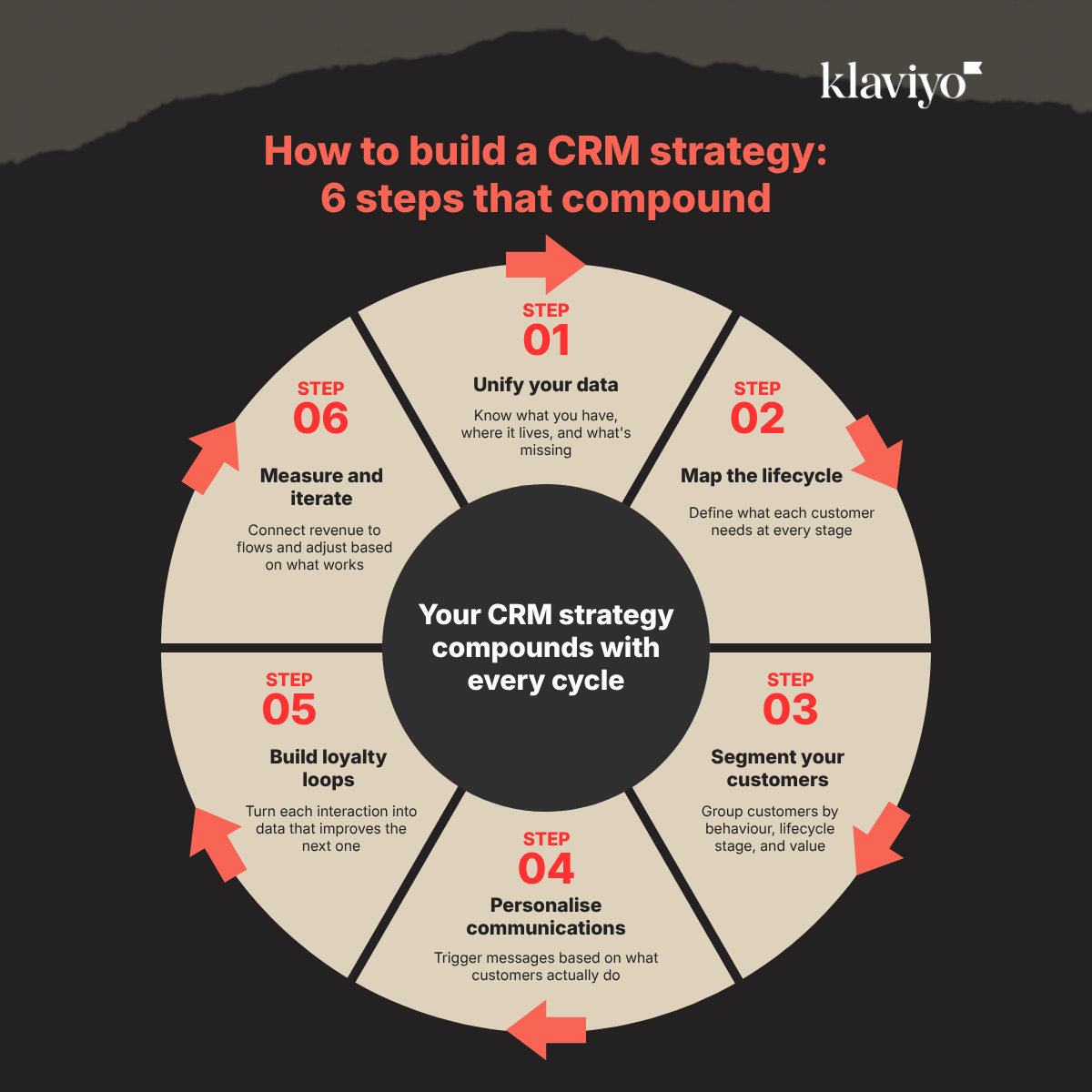
How to build a CRM strategy: 6 steps for UK B2C brands
When you build your CRM strategy, you’ll do it in layers. Getting the foundations right is what makes everything else, from segmentation to personalisation, actually work.
1. Unify your customer data
Before you can do anything meaningful with your customer data, you need to know what you actually have. A data audit means mapping what information you collect, where it lives, whether it's connected, and what's missing.
For most B2C brands, that data is spread across a handful of platforms. Purchase history and order data might live in Shopify or WooCommerce. Loyalty points and rewards activity lives in LoyaltyLion. Subscription information lives in Recharge. Email sits separately from text messaging, which sits separately from WhatsApp. Each platform knows something about your customer. Each platform only tells part of the story.
A CRM system with a built-in customer data platform (CDP) pulls all of that together into a single customer profile, showing you:
- What they bought and when
- What they browsed but didn't purchase
- When they last engaged with your marketing messages
- How they responded to your last campaign or flow
- Exactly how and why they’ve interacted with customer support
Read more about CDP benefits for B2C brands to see what that looks like in practice. The unified view a CDP gives you is the foundation of your segmentation and personalisation efforts across marketing and customer service.
2. Map your customer lifecycle and set up flows
Understanding what your customers need at each stage of the customer lifecycle, and how your brand should respond at each stage, is what turns a CRM strategy into a coherent plan rather than a collection of disconnected messages.
Lifecycle stage | What the customer needs | Your goal | What to automate at this stage |
Acquisition | A reason to trust you enough to buy | Convert interest into a first purchase. | Sign-up form that invites web visitors to sign up for marketing messages, welcome series that introduces them to your brand, and abandonment flows with customer testimonials |
First purchase | Reassurance that they made the right choice | Deliver an experience worth coming back for. | Post-purchase flow that thanks customers for their support, educates them about how to use the product, and asks them to leave a review |
Repeat purchase | Relevance and recognition | Deepen the relationship and increase value. | Cross or up-sell flow that recommends other products the customer might enjoy, based on their unique purchase history |
Loyalty | To feel genuinely valued, not just rewarded | Build advocacy and long-term retention. | Loyalty flows that keep members and VIPs informed about their points, status, and special perks |
Win-back | A compelling reason to return | Re-engage before they're gone for good. | Win-back flow that incentivizes a lapsed customer to come back and make a purchase |
3. Segment your customers
Flows like the ones we just covered are inherently personalised because they're triggered by a specific action someone takes, like signing up for your email newsletter or abandoning a cart on your website.
Segmentation, meanwhile, is the first step in personalising your campaigns. It's how you stop sending the same message to everyone, and start communicating in ways that are actually relevant to each recipient.
In practice, that means grouping your audience based on:
- Demographic data: location, gender, device, etc.
- Behavioural data: browsing patterns, purchase history, marketing engagement, customer service interactions, etc.
- Lifecycle stage: first-time buyer, repeat purchaser, lapsed customer, etc.
- Predictive analytics: expected next order date, predicted lifetime value (LTV), churn risk, etc.
- Recency, frequency, monetary (RFM) analysis: how recently someone bought, how often they buy, and how much they spend
What makes modern segmentation powerful is that it’s not static. Your CRM platform should update segments dynamically as customer behaviour changes, so a customer moves from "active" to "at risk" automatically as their engagement drops, for example.
Good customer segmentation examples and a solid email segmentation and personalisation guide can help you build this out in practice.
4. Personalise your communications
Once you know which customers you're talking to, the next question is what to say to each of them individually.
Two customers in the same repeat buyer segment, for example, might be in very different places. Where one might have just hit their third order and is close to VIP status, the other maybe hasn't purchased in 45 days and is starting to drift.
A CRM strategy accounts for that difference. The first customer might get a campaign inviting them to an early-access VIP preview to reward the momentum and push them over the threshold. The second gets a win-back campaign with a "we miss you" subject line and an incentive to come back before they churn for good. Same original segment, two completely different messages, because the underlying data tells two different stories.
Getting it right means connecting customer data patterns to every message you send. For example:
- Promoting your new Manchester pop-up to a location-based segment in the UK, while customers in France get a completely different message about your Paris launch
- Offering your VIP segment early access to a new collection 48 hours before it goes public
- Announcing a new serum to a product category affinity segment of skincare buyers, while your haircare buyers hear about a new shampoo line instead
- Testing a win-back offer on a lapsed customer segment that hasn't opened an email in 60 days
- Featuring premium bundles to a high-AOV segment, while your entry-price segment sees your best-sellers under £30
Each of these is an example of personalising your marketing campaigns based on something a specific customer actually did or experienced, not based on a generic campaign calendar.
5. Build loyalty loops
A loyalty programme is the structured system you use to reward customers for staying, spending, and engaging with your brand over time. Points, tiers, perks, member-only access, early drops, referral incentives. It sits inside your broader CRM strategy because the programme is only as good as the data, communications, and automation running behind it. Without those, membership numbers climb while actual engagement flattens.
Research from Antavo found that 74% of loyalty programme members stop engaging after two months while keeping their membership. If you’re worried that’s your customers, it probably means the infrastructure and strategy behind your loyalty programme isn’t doing the work.
A loyalty loop is the cycle that forms when a customer action results in a communication, that communication prompts a response, and that response generates data that makes the next communication more relevant than the last. Each cycle builds on the one before it.
Making that work in practice comes down to 3 elements:
- A message that prompts re-engagement at the right moment, like a points balance nudge or a tier upgrade notification
- A reward that feels genuinely worth returning for
- A follow-up that keeps the relationship moving rather than letting it go quiet
6. Measure and iterate
Standard CRM reporting gives you a baseline set of numbers. Most platforms surface these by default:
- Repeat purchase rate: the percentage of customers who buy more than once
- Customer churn rate: the percentage who stop buying over a given period
- LTV: the total revenue a customer generates across their relationship with you
- Engagement rates by segment: how different customer groups respond to your communications
- Support ticket volume and resolution status by segment: whether customers with open or recently resolved customer service interactions are converting, lapsing, or disengaging at different rates compared to those who haven't contacted support
These tell you what has already happened. They're the foundation, and tracking them consistently is how you spot when something in your CRM strategy hasn’t gone according to plan.
The next level of measurement connects those numbers directly to the flows and campaigns that drove them. A B2C CRM platform shows you attributed revenue at the individual flow or campaign level, so you can see what each automated sequence and message is actually earning.
Here’s what flow-level attribution looks like in practice:
- Your abandoned cart flow generated £12,400 last month.
- Your post-purchase cross-sell flow generated £4,200.
- Your win-back flow generated £890.
Now, you know where to put your attention. The win-back flow might need a stronger offer, better timing, or a tighter audience. You know because the revenue is attached to the flow itself, not buried in a monthly export.
CRM strategies in action: what UK ecommerce brands are doing
Here are some examples of UK brands doing CRM strategy well.
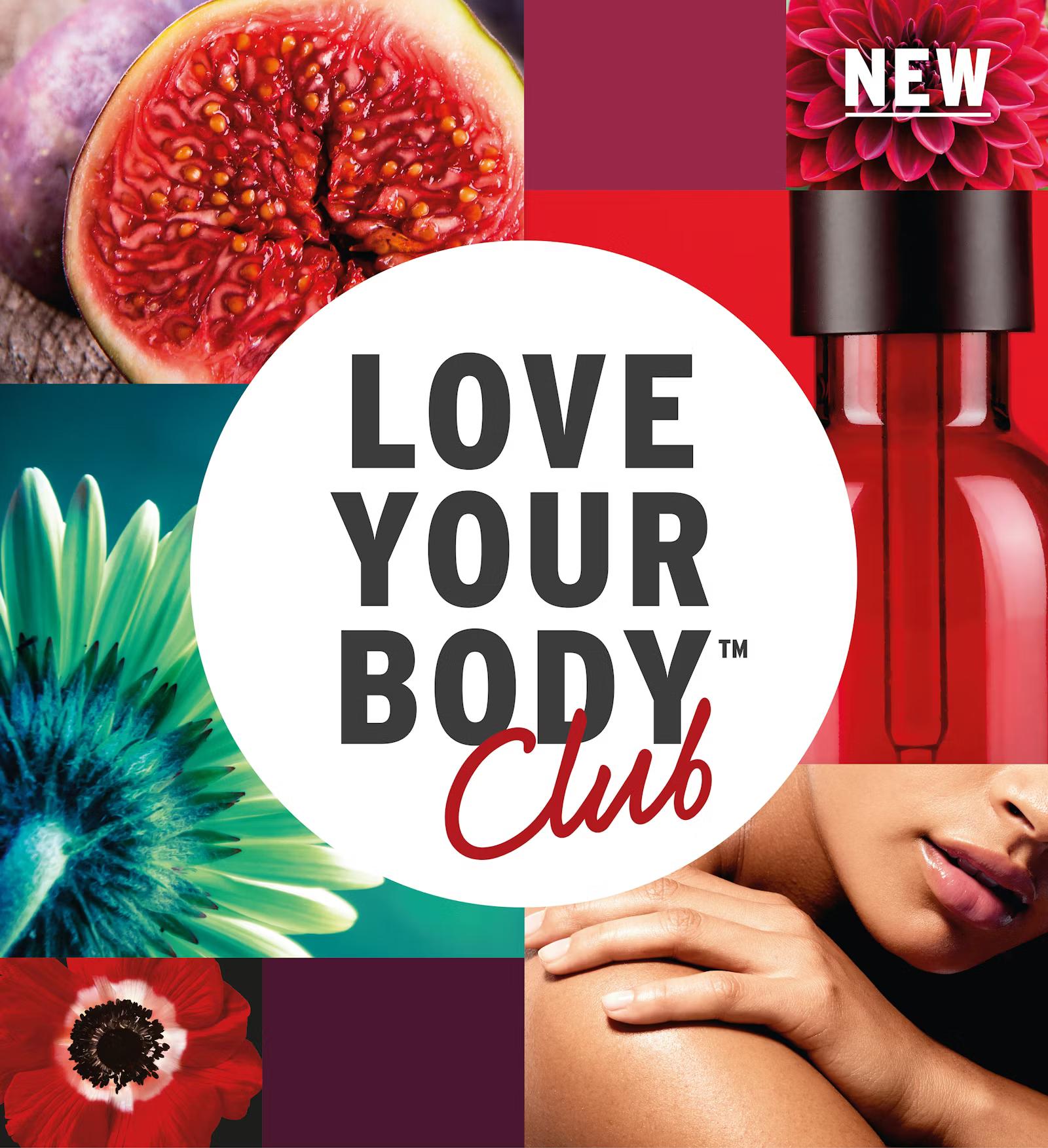
Skincare brand The Body Shop's Love Your Body Club has been running in the UK for 15 years, connecting loyalty data across channels in ways that go beyond a standard points programme. Members earn points toward vouchers, get early access to new product launches and sales, receive a birthday reward, and hear about member-only promotions by email throughout the year. The same customer data that powers those communications also informs how the brand understands and serves its customers across every other touchpoint.
Members can check their points balance and redeem vouchers in the mobile app or online, with purchases from both channels feeding into the same account. The programme keeps the relationship active between purchases, and the same customer data that powers those communications also informs how the brand understands and serves its customers across every other touchpoint.
ICONIC London, a luxury UK make-up brand, shifted from generic email campaigns to behaviour-based segmentation, targeting customers with market-specific content based on their shopping behaviour. In under a year, CRM revenue grew 42%, with email open rates up 130% and UK SMS revenue up 197% YoY.
Advanced segmenting and clear analytics have allowed us the flexibility to target customers with market-specific content based on shopping behaviours. These crucial insights helped us dramatically increase our email and SMS revenues.
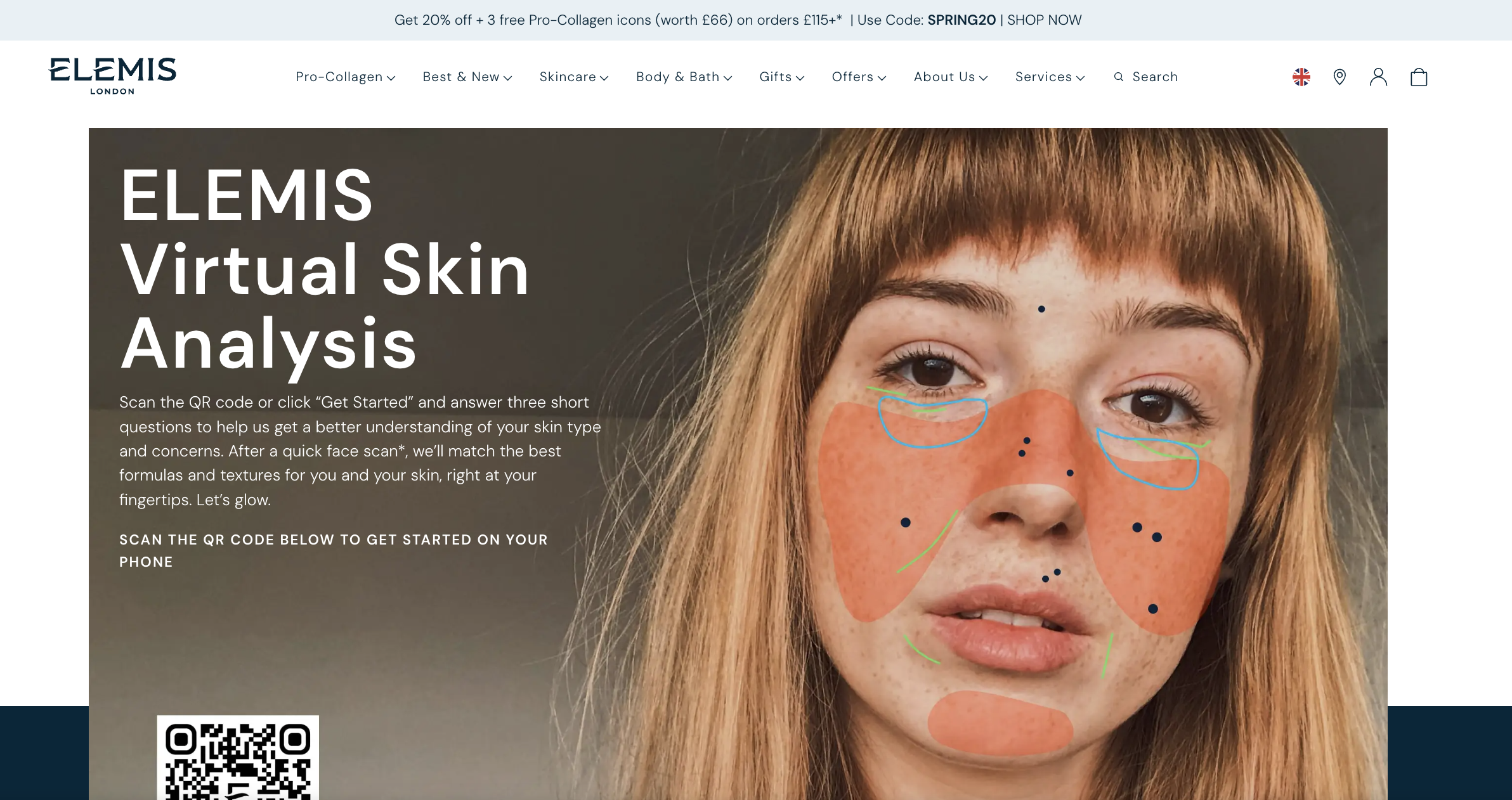
Skincare brand Elemis builds personalisation in from the very first interaction. Their virtual skin analysis captures individual skin type and concerns before a customer has even made a purchase, then uses that data to deliver a personalised skin wellness plan and product recommendations. Rather than waiting for purchase history to accumulate, the brand starts building a personalised relationship from the moment someone engages.
Choosing the right CRM software for your ecommerce brand
The most useful question to ask when evaluating a CRM platform is whether it connects customer data to the full customer lifecycle, from marketing to customer service to retention, without requiring a data team to sit in between. If acting on an insight means an export, a build request, or waiting on another team, the platform is creating friction rather than removing it.
Here are 4 capabilities are worth looking for in a CRM platform:
- Real-time customer profiles that update as behaviour changes, not in overnight batches
- Automatic segmentation that moves customers between audiences as their behaviour shifts
- Native email marketing, mobile marketing, and customer service, so your data and your activation live in the same place
- Revenue-linked reporting that connects campaign and flow performance directly to sales
Those questions are important because the gap between a CRM strategy that generates data and one that generates revenue comes down to whether your customer data, your communications, and your reporting all operate from the same place. When they do, every adjustment you make to a flow, a segment, or an offer reflects immediately in what you send next.
Klaviyo is built specifically for B2C brands that want that connection without needing a data team to maintain it. Your customer profiles, automated flows, email and text message marketing, customer service interactions, and revenue reporting all live in one platform, updated in real time as your customers interact with your brand.
Ready to build a CRM strategy that works across the full customer lifecycle?
Frequently asked questions about CRM strategies
What is the difference between a CRM strategy and CRM software?
A CRM strategy is the plan: who your customers are, what they need at each stage of the lifecycle, how you'll communicate with them, how you'll support them, and how you'll measure whether it's working. CRM software is the technology that makes the strategy possible at scale.
The distinction matters because brands often invest in software before they have a strategy. A CRM platform gives you the capability to segment, automate, and report, but the decisions about which segments to build, which moments to act on, and what “good” looks like across both marketing and customer service still need to come from you. The strategy determines whether the software creates value.
What CRM metrics should ecommerce brands track to measure success?
The most useful metrics connect customer behaviour to revenue across the full lifecycle. On the marketing side, that means repeat purchase rate, lifetime value, churn rate, engagement rates by segment, and revenue attributed to automated flows. On the customer service side, it means tracking support ticket volume by segment and whether customers who've had recent support interactions are converting, lapsing, or disengaging at different rates to those who haven't. An analytics dashboard that separates these into silos gives you an incomplete picture. The most useful CRM reporting connects both.
How do CRM strategies differ for B2C vs. B2B ecommerce brands?
Using the wrong one for your model creates friction at every level. A B2C CRM platform is built around individual customer profiles, behavioural data, and omnichannel engagement across email, text message marketing, WhatsApp, and push. A B2B CRM is built around pipeline management, lead scoring, and account hierarchies.
How long does it take to see results from a CRM strategy?
Some results come quickly. A well-built abandoned cart flow or a post-purchase sequence can generate attributed revenue within days of going live.
The honest answer is that CRM strategy is a compounding investment. The data you collect in the first month one makes your segmentation better in the third. The segments you build in the third month make your messages more relevant in the sixth. Sustainable business growth through CRM strategy comes from consistent iteration, not a single campaign. Data-driven techniques improve over time as your customer profiles become richer and your understanding of what drives conversion and retention in your specific market deepens.
What is the role of AI in modern CRM strategies for ecommerce?
CRM AI operates across 3 key areas. In segmentation, it generates audience conditions from natural language prompts and allows you to build predictive segments based on expected next order date, predicted lifetime value, and churn risk, so you're acting on what customers are likely to do rather than just what they've already done. In personalisation, it generates brand-aligned copy and content for different audiences, powers product recommendations, and optimises send timing and channel routing. In customer service, AI customer agents handle routine queries, surface relevant customer context to human agents, and flag when a support interaction should trigger or suppress a marketing communication.
When predictive modelling, personalised communication, and customer service all operate from the same customer data foundation, the decisions your CRM makes about when to reach a customer, what to say to them, and when to hold back become genuinely intelligent rather than just automated.
How do UK data protection laws affect CRM strategy for ecommerce brands?
UK GDPR requires that customer data is collected with a lawful basis, stored securely, used only for the purposes it was collected for, and deleted when no longer needed. For CRM strategy, the most practical implications are around consent and contact management.
To communicate with users, you need explicit opt-in consent. That means your CRM needs to capture, store, and honour consent status accurately. Sending to customers who haven't opted in, or continuing to contact customers who have withdrawn consent, creates both compliance risk and deliverability problems.
The same applies to data you collect through customer service interactions. If a customer contacts support, you can use that data to resolve their issue and improve their experience, but using it for marketing purposes requires consent. A CRM strategy that unifies marketing and customer service data needs to account for this distinction at the point of data collection, not after.

Related content